Connected Data Products Hackdays Overview
Trey Stafford 
Robyn Marowitz
Luis López
2026-05-13
Connected Data Products Hackdays
- Berkeley, CA April 13-15
- Co-hosted by Englacial and Berkeley Institute for Data Science.
- Focus on bringing together members of the cryospheric data science community to explore connected and living data products.
- April 13: Presentations/demos and ideas formation
- April 14-15: Hack time!
The group
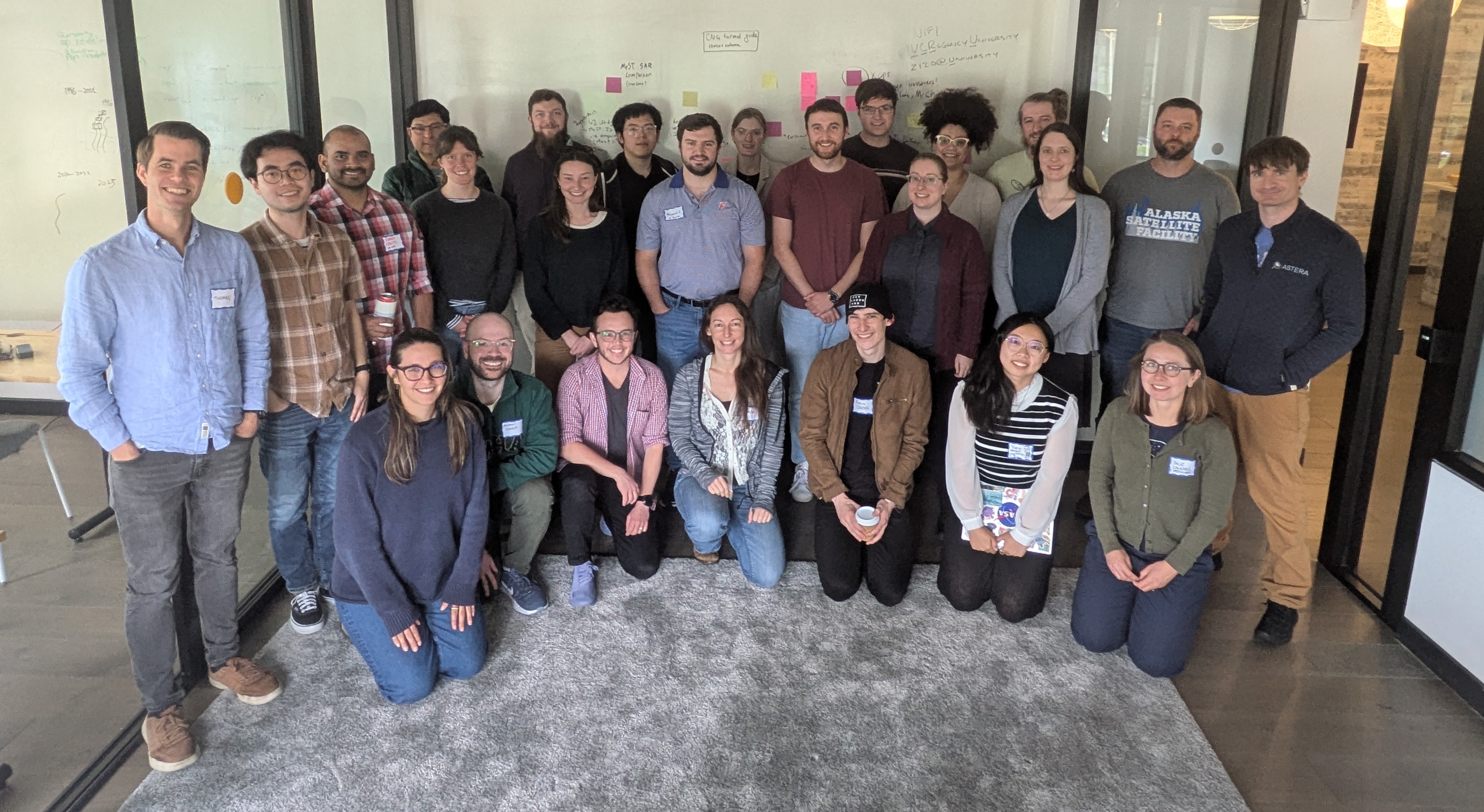
Image courtesy of Englacial
Demos/Presentations
- Open Polar Radar Tools (xopr): Python package for accessing and analyzing CReSIS radar depth sounder data.
- icepyx: Python library for searching and accessing IceSat2 data.
- GStatSim: Python package for geostatistical interpolation methods.
- NISAR data at ASF DAAC.
- Arcadia bioscience overview and demo of The Stacks scientific publishing platform.
- MyST for scientific publishing with markdown.
- Source Cooperative: nonprofit publishing of scientific data to cloud infrastructure.
- Cloud-Native Geospatial Forum overview and data formats guide
- Cryocloud: Collaborative Earth Science Platform in the cloud.
- VirtualiZarr and IceChunk.
- ISMIP 6 Model Viewer
Hack projects
- earthaccess v1.0 updates
- Virtualization of datasets for efficient cloud access (e.g,. radar sounder data).
- Analysis of velocity changes at grounding zones.
- Analysis of radar echo sounding crossovers with IceSat2 crossovers.
- Geostatistics/Interpolation of data with GStatSim.
Englacial posted a nice writeup of the hackdays projects here:
https://englacial.org/posts/20240428-hackdays-projects/index.html!
earthaccess v1 hacking
- Trey, Joe Kennedy (ASF), Julia Lober (graduate student at Boise State), Matt Fisher (DSE), and Jessica Scheick (U. of New Hampshire)
- The project is working toward a v1 release, and there are various milestones/breaking changes that we want to complete before v1 is done.
- We ended up focusing on updates to the results API, and providing convenience methods/properties to the
Resultsclass (e.g., we added the ability to export to GeoDataframe and worked toward attaching query provenance to the results). - Associated PR: https://github.com/earthaccess-dev/earthaccess/pull/1298
- Lots of people expressed interest in this work, and were excited for the changes. Almost all of the projects (maybe all) used earthaccess.
GStatSim: New Applications for Large Radar Datasets
- Team: Robyn Marowitz, Eliza Dawson (NOAA C&GC Postdoc Fellow, Georgia Tech), Joseph Rotondo (UW grad student), Lindsay Stark (Boise State grad student), Emmy Muniz (Stanford undergraduate student)
- Expanded the GStatSim Jupyter Book documentation with two new real-world application notebooks:
- HiCARS radar sounder — end-to-end workflow: downloading 860 granules from NSIDC via
earthaccess, parsing flight-line text files into a single GeoParquet (9.3M points, EPSG:3031), and fitting variogram models for kriging and geostatistical simulation - Arctic pole hole — filling the gap in satellite sea-ice coverage near the pole using geostatistical interpolation of sea-ice albedo
- HiCARS radar sounder — end-to-end workflow: downloading 860 granules from NSIDC via
- Together these notebooks demonstrate real-world approaches to connecting datasets through an open-source package to produce a new data product
- Repo: https://github.com/elizadawson/gstatsim_largedatasets
Common themes
- Data archived in the cloud is not always “cloud-optimized” or “AI-ready”. Significant interest in data virtualization techniques (e.g, VirtualiZarr, IceChunk)
- Importance of living/executable documentation (e.g,. via MyST).
- Discussions about how to maintain citations for products that receive updates from a rotating cast of contributors.
- The role of AI in scientific software/product development (e.g., Jupyter AI).
- Reproducibility in science is more than just being open. Can AI be used as a “reproducibility checker”?
- Challenges with scaling notebooks to production
- Challenges with co-locating and co-analyzing data that were not “designed” to work together natively.